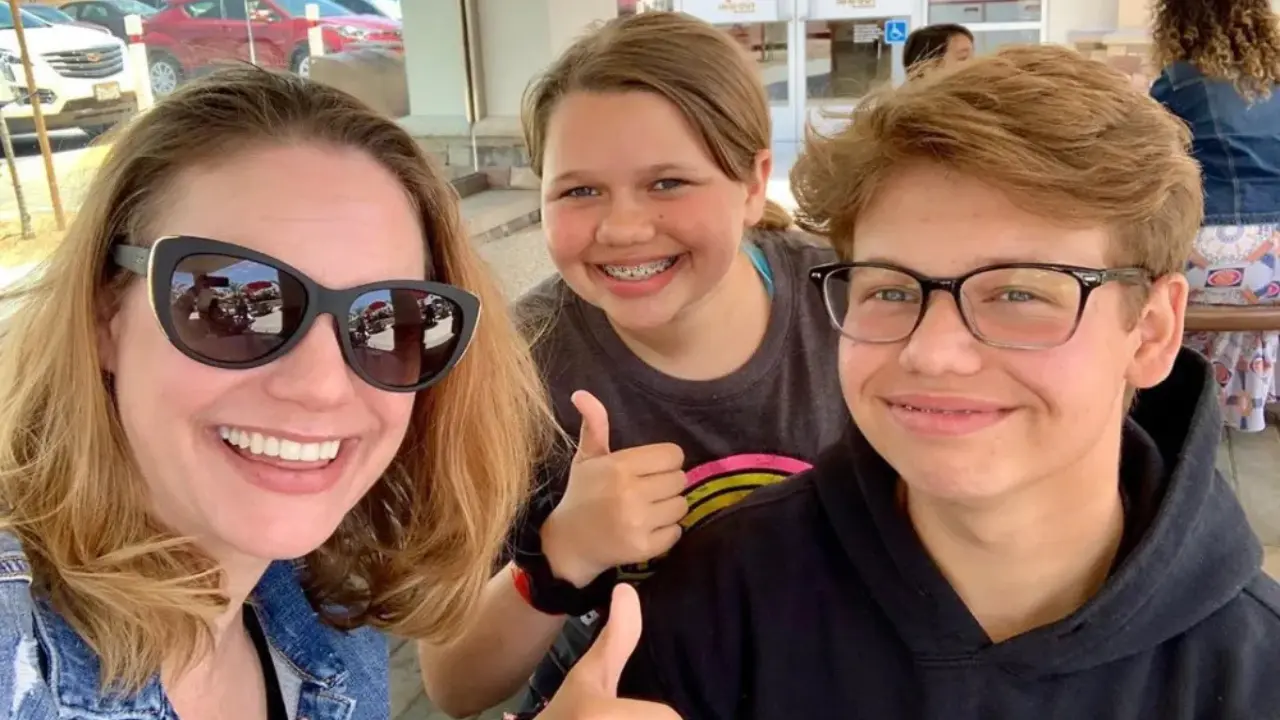
Tate James Rytky – Everything About His Life, Family, and Background
Tate James Rytky is a young American man who has grown up in the particular kind of environment that comes from having a mother who is genuinely beloved by millions of television viewers. His mother is Andrea Barber, the actress who brought Kimmy Gibbler to life on Full House, the ABC family sitcom that ran from 1987 to 1995 and became one of the most warmly remembered television programs in American broadcasting history. When Fuller House, the Netflix revival, arrived in 2016 and ran through 2020, Andrea reprised Kimmy Gibbler for a new generation of viewers while also winning over people who had loved the original show from childhood. For Tate, growing up as Andrea Barber’s son means growing up with a mother whose professional identity is tied to one of the most genuinely affectionate characters in the history of American family television.
He is a young man who has maintained a private life despite the public recognition that his mother’s career has made available by association. That choice — to remain private rather than stepping into any public role that the famous parent connection might facilitate — reflects both his own natural orientation and his mother’s deliberate approach to protecting the privacy of her children even as she has been a visible and engaged public figure in her own right.
Tate’s story at this stage of his life is the story of a young person who is building his own identity in his own time, supported by a mother who has been publicly honest about the personal struggles she has navigated alongside her professional success, and who has modeled for her children what it looks like to be genuinely authentic even when that authenticity involves sharing difficult truths.
Quick Bio Table
| Detail | Info |
| Full Name | Tate James Rytky |
| Date of Birth | Not publicly confirmed (estimated mid-2000s) |
| Age | Estimated late teens (as of 2025) |
| Birthplace | United States |
| Nationality | American |
| Ethnicity | Caucasian American |
| Mother | Andrea Barber (actress, Full House, Fuller House) |
| Father | Jeremy Rytky (ex-husband of Andrea Barber) |
| Sister | Felicity Ruth Rytky |
| Maternal Grandparents | Not publicly documented |
| Paternal Grandparents | Not publicly documented |
| Spouse / Partner | Not applicable |
| Children | Not applicable |
| Height | Not publicly confirmed |
| Weight | Not publicly confirmed |
| Profession | Student / Not publicly confirmed |
| Net Worth | Not applicable |
| Mother’s Net Worth | Estimated $3–5 million |
| Residence | United States |
| Social Media | No known public presence |
Early Life and Growing Up Rytky
Tate James Rytky has spent his early life in the United States, growing up as one of two children of Andrea Barber and her former husband Jeremy Rytky. The specific details of his early childhood, including where the family lived during his youngest years and what his daily life looked like, have not been comprehensively documented in public sources. Andrea Barber has been protective of her children’s privacy across the years of their upbringing, which means that what is publicly known about Tate is limited by that deliberate protection rather than by any absence of richness in his actual life.
What can be understood from the broader context of his family situation is that his childhood was shaped by significant personal changes. His parents, Andrea and Jeremy Rytky, divorced, and Andrea has spoken about that period of her life with considerable candor in various public contexts, including in her memoir about dealing with depression, anxiety, and personal reinvention. The divorce and its aftermath were clearly a formative period for the whole family, including for Tate, who navigated those changes alongside his sister Felicity.
Andrea Barber’s openness about her own mental health journey — she wrote and published a memoir called Full Circle that addressed her experiences with depression and anxiety and her path toward recovery — reflects a parent who values honesty about difficult experiences over the maintenance of a polished public image. That quality in his mother would have given Tate a specific kind of emotional education, growing up in a household where real feelings were named and acknowledged rather than smoothed over.
His sister Felicity Ruth Rytky is his only sibling, and together they have navigated the particular childhood experience of having a mother whose professional identity is tied to a character and a show that millions of people feel genuine affection for. Being the child of Kimmy Gibbler is a specific kind of thing in American pop culture terms, and whatever that has meant in Tate’s social life, his school experiences, and his relationship to his mother’s public persona is part of the texture of his growing up.
His Mother Andrea Barber – The Professional and Personal Journey
Andrea Barber is the actress whose portrayal of Kimmy Gibbler across two television series has made her one of the more genuinely beloved supporting performers in the history of American family television. She was born on July 3, 1976, in Los Angeles, California, and came to acting early, as many child performers of her generation did, through the particular environment of 1970s and 1980s Los Angeles where the television industry created consistent opportunities for young performers who had the combination of natural ability and parental support that getting into the business required.
Her early acting career included appearances in television productions during her childhood before the role that would define her professional legacy arrived. She joined the cast of Full House in 1987 when she was eleven years old, playing Kimmy Gibbler, the best friend of D.J. Tanner, the eldest daughter in the Tanner family household at the center of the show. The character was immediately distinctive — loud, confident, oblivious to social convention, and utterly devoted to her friendship with D.J. — and Andrea brought to her a comedic energy and a genuine warmth that made Kimmy one of the show’s most memorable presences despite being nominally a secondary character.
Full House ran for eight seasons from 1987 to 1995, producing 192 episodes that followed the Tanner family through the full range of family sitcom situations with a consistent warmth and a genuine emotional earnestness that the show’s creators maintained throughout. The show became one of the most successful in ABC’s history and produced a cast that remains, decades later, closely connected to the public affection for the material.
After Full House ended in 1995, Andrea Barber made a decision that distinguished her from many child actors of her generation. She stepped away from the entertainment industry and pursued higher education, attending Whittier College in California, where she earned her undergraduate degree. That choice — to leave a profession she had been in since childhood in order to build a conventional academic and personal life — reflects someone with a clear sense of what she wanted her life to include beyond professional performance.
She married Jeremy Rytky, and together they had Tate and Felicity before the marriage eventually ended. The years of her marriage and early motherhood coincided with the period when she was not actively working in entertainment, which means that Tate’s earliest years were spent with a mother who was primarily focused on family life rather than on a working acting career.
Her personal struggles with depression and anxiety during those years, which she has spoken about publicly and which form the heart of her memoir Full Circle, reflect a person who was navigating significant internal difficulty alongside the external demands of parenting and a major life transition. The honesty with which she has told that story publicly — not as a celebrity confession designed to generate sympathy but as a genuine account of what depression looks like and what recovery involves — has made her an important voice for many people who have had similar experiences.
The Fuller House opportunity, when Netflix revived the Full House universe in 2016, brought Andrea back to professional acting after years away, and the warmth of the public response to Kimmy Gibbler’s return reflected how genuinely people had held on to their affection for the character and for Andrea. The show ran through five seasons, concluding in 2020, and gave Andrea Barber a second chapter of professional recognition that was in many ways richer and more consciously appreciated than the first because both she and the audience had lived enough life in between to understand what the original show had meant.
His Father Jeremy Rytky and the Family Structure
Jeremy Rytky is Tate’s father and Andrea Barber’s former husband. He has maintained a private life that has not been the subject of any significant public documentation. His professional background and personal history are not matters of public record in any comprehensive way.
The divorce between Andrea and Jeremy produced the family structure that Tate has grown up within, with both parents navigating co-parenting across two separate households. Andrea has spoken about the divorce in the context of the personal difficulties she experienced during that period, characterizing it as one of the significant challenges of her adult life that she worked through alongside her mental health journey. The specific dynamics of how she and Jeremy have managed parenting together in the years since the divorce have not been publicly detailed.
For Tate, having parents who are no longer together but who are both invested in his wellbeing is the family reality he has known across his formative years. How that has shaped his understanding of relationships, commitment, and family life is something that only he could speak to directly, and it is part of his private biographical story rather than anything that belongs to the public record.
Kimmy Gibbler’s Cultural Legacy and What It Means to Be Her Son
One of the more distinctive dimensions of Tate James Rytky’s family experience is the particular relationship his mother has to American popular culture through the Kimmy Gibbler character. Kimmy Gibbler is not simply a television character. She is a genuinely beloved figure who has represented for millions of viewers a specific kind of gleeful, unapologetic, best-friendship-devoted personality that resonated deeply with the show’s audience.
The affection for Kimmy Gibbler is genuine and durable. When Fuller House premiered, one of the most anticipated elements was seeing how Kimmy had developed as a character into adulthood, and the audience’s enthusiasm for Andrea’s return to the role reflected how strongly people had maintained their connection to the character across the twenty-one years between Full House and Fuller House. That kind of sustained cultural affection is relatively rare, and the people who produce it tend to carry a specific kind of recognition that persists beyond any reasonable expectation.
For Tate, having a mother who is recognized and greeted with genuine warmth in public settings because of a character she played — recognizable not just as an actress but as Kimmy Gibbler specifically — is a specific kind of experience. There is probably something both wonderful and occasionally strange about being in a grocery store or at a school event and watching strangers light up when they recognize your mother as someone they have loved since childhood. That dynamic is part of the texture of what it means to be Andrea Barber’s son.
Andrea Barber’s Mental Health Advocacy and What It Modeled
One of the more significant things about Tate’s particular family context is his mother’s public engagement with mental health issues through her memoir and her subsequent advocacy around depression, anxiety, and recovery. Full Circle, published in 2017, recounted Andrea’s personal journey through what she described as a severe period of depression that coincided with significant personal changes in her life, including her divorce. The book was received with genuine warmth by many readers who recognized their own experiences in her account.
By being publicly honest about mental health struggles at a time when the conversation around those issues was still more stigmatized than it has subsequently become, Andrea Barber contributed to a broader cultural shift in how public figures relate to their own psychological wellbeing. For many people who read the book or heard her speak about it in interviews, the knowledge that someone they associated with a cheerful and beloved television character had also experienced profound personal darkness was both surprising and reassuring in the specific way that honest accounts of shared human difficulty tend to be.
For Tate, growing up in a household shaped by that journey — his mother’s experience of depression, her path toward recovery, and her eventual decision to share that experience publicly — is a specific kind of emotional and psychological formation. It is the formation of a young person who has been around genuine human complexity rather than its performed version, who has seen what it looks like to struggle and to work through struggle and to eventually be honest about it.
Privacy as a Family Value
Andrea Barber’s consistent protection of her children’s privacy, maintained across the years of Fuller House’s run and her increased public visibility during that period, reflects a clear and deliberate family value rather than simply an incidental circumstance. She has been willing to be publicly engaged about her own professional life, her own mental health journey, and her own experience of personal reinvention. She has not extended that public engagement to include her children.
That distinction — between sharing her own story and protecting her children’s privacy — reflects thoughtful parenting from someone who understands both the value and the cost of public exposure. Tate and Felicity have been given the space to grow up without the particular distortions that public attention creates in young people, which is a genuine gift in an era when the children of public figures are increasingly visible through their parents’ social media presences.
Tate has no known public social media accounts, which at his age in contemporary American adolescence is genuinely unusual and reflects either personal preference or a family approach that discourages it. Either way, his absence from public digital spaces means that his development as a person is happening in private, which is where it belongs.
What the Future Holds for Tate James Rytky
Tate James Rytky is in his late teens as of 2025, which puts him at the stage where major life choices are being made or approaching — the transition between secondary education and whatever comes next, whether that is higher education, professional training, or some other path. He has grown up with a mother whose professional trajectory demonstrated both the value and the limitation of an early acting career, and who made a point of pursuing education alongside and beyond professional performance.
Whether Tate has any interest in acting, in the entertainment industry generally, or in any other field is something that has not been made public. Whether he has his mother’s comedic instincts, his own distinct creative sensibilities, or entirely different aptitudes is similarly unknown. He is at the age where those things are still being discovered and developed, and the absence of any public record of his professional interests means the field genuinely remains open.
What can be said with confidence is that he has been given genuine love, genuine honesty about the world’s complexity, and genuine space to develop into whoever he is going to be. That is a meaningful foundation, and whatever he builds on it will be entirely and appropriately his own.
Net Worth and Financial Context
Tate James Rytky is too young to have any meaningful independent net worth, and his financial situation is defined entirely by his family circumstances. Andrea Barber’s net worth has been estimated at approximately three to five million dollars by various entertainment finance sources, reflecting a career that includes eight seasons of Full House, five seasons of Fuller House, her memoir, and her advocacy work. That financial foundation provides stability for Tate and his sister Felicity as they continue their education and development.
Jeremy Rytky’s financial situation has not been publicly documented in any way that allows for any estimation.
Final Thoughts
Tate James Rytky is the son of Andrea Barber, one of American family television’s most genuinely beloved actresses, and Jeremy Rytky, a private individual whose life has remained outside the public record. He has grown up in a household shaped by creative achievement, personal honesty about mental health, genuine love for family, and deliberate protection of private life.
His mother played one of television’s most memorable best friends for two separate generations of viewers and then wrote honestly about the depression and personal struggle that accompanied the years between those two acting chapters. The household that produced Tate James Rytky is one that has valued authenticity over performance, privacy over publicity, and genuine human experience over polished public image.
At his current age, Tate’s best chapters are entirely ahead of him. Whatever he builds will be built on a foundation of genuine love and genuine honesty, which is about as good a foundation as anyone can hope for.